Article Detail
Assessing the Gap Between Regulation and Reality: Community Perspectives and Spatial Siting of Gas Stations in Kumasi, Ghana
Keywords:
LPG filling stations
spatial siting
perceived environmental impacts
regulatory enforcement
buffer zone compliance
Kumasi
Abstract
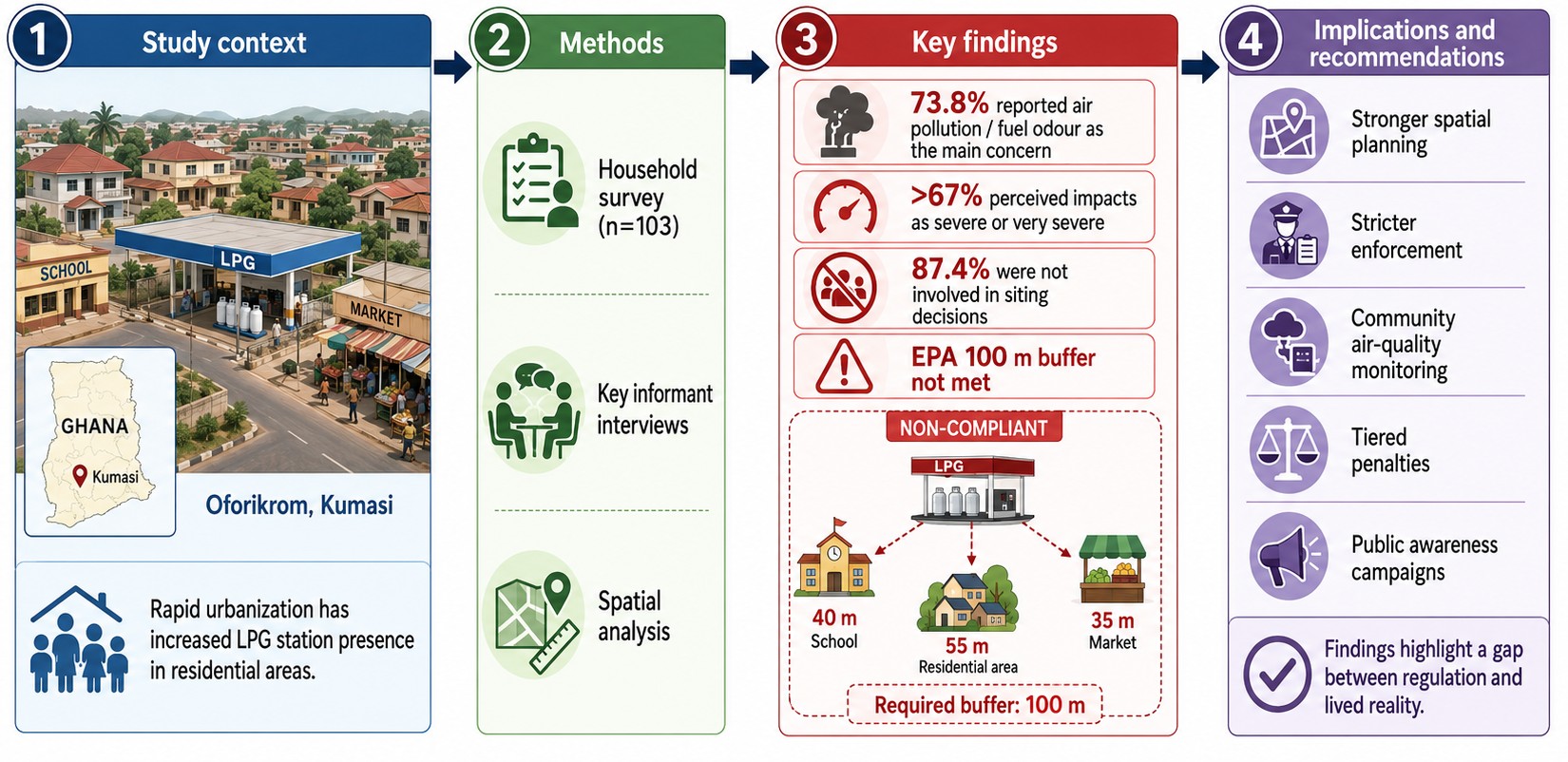
In this study, the perceived environmental impacts of gas filling stations and their compliance with buffer zone regulations were evaluated in Kumasi, Ghana’s second-largest city. Rapid urbanization has increased energy demand and contributed to the expansion of Liquefied Petroleum Gas (LPG) stations into residential areas. Although LPG is regarded as a cleaner fuel option, its distribution infrastructure may create environmental and safety risks when poorly sited or inadequately regulated. A mixed-method design was employed, combining a household survey (n = 103), spatial analysis, and key informant interviews with station managers, assembly members, and environmental regulators in the Oforikrom sub-metropolis. The findings show substantial community concern regarding gas filling stations. Air pollution, including fuel odours and possible exposure to volatile organic compounds (VOCs), was the most frequently reported issue, cited by 73.8% of respondents. More than two-thirds of residents perceived the overall environmental impact as severe or very severe. Spatial analysis of one station at Anloga Junction revealed non-compliance with the EPA’s mandatory 100-meter buffer zone, with the station located only 40 m from a school and 35 m from a market. In addition, awareness of chronic health risks was limited, and 87.4% of respondents reported no involvement in station siting decisions. The findings suggest that current enforcement remains largely reactive and constrained by limited resources. The study recommends stronger spatial planning, stricter enforcement, community-based air quality monitoring, tiered penalties, and locally appropriate public awareness campaigns.
References
- Abdulai, I.A., Abubakari, M.A., File, D.J.M.-B. (2024). Siting of fuel stations within residential areas in Ghanaian cities. Heliyon, 10(8), doi: 10.1016/j.heliyon.2024.e29964.
- Antwi, R., Okai, S., Quaye, J., Özgüven, E.E. (2024). Geospatial analysis of fuel and gas station distribution in Kumasi, Ghana. Computational Research Progress in Applied Science & Engineering, 10(1), 1-19, doi: 10.61186/crpase.10.1.2885.
- Bishoge, O.K., Zhang, L., Mushi, W.G., Matomela, N. (2019). A literature survey of community participation in the natural gas sector in developing countries. International Journal of Energy Sector Management, 13(4), 765-786, doi: 10.1108/IJESM-11-2018-0003.
- Chaiklieng, S., Suggaravetsiri, P., Autrup, H. (2019). Risk assessment on benzene exposure among gasoline station workers. International Journal of Environmental Research and Public Health, 16(14), 2545, doi: 10.3390/ijerph16142545.
- Crentsil, A.O., Asuman, D., Fenny, A.P. (2019). Assessing the determinants and drivers of multidimensional energy poverty in Ghana. Energy Policy, 133, 110884, doi: 10.1016/j.enpol.2019.110884.
- Dongzagla, A., Adams, A.M. (2022). Determinants of urban household choice of cooking fuel in Ghana: Do socioeconomic and demographic factors matter?. Energy, 256, 124613, doi: 10.1016/j.energy.2022.124613.
- Dongzagla, A., Baddianaah, I., Avogo, F.A., Tengbane, J. (2023). Conformity of filling stations to safe distance guidelines in urban Ghana: A case study of the Wa Municipality. Cogent Social Sciences, 9(2), 2282473, doi: 10.1080/23311886.2023.2282473.
- EPA Ghana. (2020). Ghana’s Fourth National Communication to the United Nations Framework Convention on Climate Change. www.epa.gov.gh, version (02/2026).
- Fei-Baffoe, B., Badu, E., Miezah, K., Sackey, L.N.A., Sulemana, A., Amuah, E.E.Y. (2024). Contamination of groundwater by petroleum hydrocarbons: Impact of fuel stations in residential areas. Heliyon, 10(4), doi: 10.1016/j.heliyon.2024.e25924.
- Fetisov, V., Gonopolsky, A.M., Davardoost, H., Ghanbari, A.R., Mohammadi, A.H. (2023). Regulation and impact of VOC and CO2 emissions on low‐carbon energy systems resilient to climate change: A case study on an environmental issue in the oil and gas industry. Energy Science & Engineering, 11(4), 1516-1535, doi: 10.1002/ese3.1383.
- Frimpong, B.F., Molkenthin, F. (2021). Tracking urban expansion using random forests for the classification of landsat imagery (1986–2015) and predicting urban/built-up areas for 2025: A Study of the Kumasi Metropolis, Ghana. Land, 10(1), 44. doi: 10.3390/land10010044.
- Graham, E., Ackah, I., Gyampo, R. (2016). Politics of oil and gas in Ghana. Insight on Africa, 8(2), 131-141, doi: 10.1177/0975087816655015.
- Hilpert, M., Mora, B.A., Ni, J., Rule, A.M., Nachman, K.E. (2015). Hydrocarbon release during fuel storage and transfer at gas stations: environmental and health effects. Current Environmental Health Reports, 2(4), 412-422, doi: 10.1007/s40572-015-0074-8.
- Mehaffy, M.W., Elmlund, P., Farrell, K. (2019). Implementing the New Urban Agenda: the central role of public space. Urban Design International, 24(1), 4-6, doi: 10.1057/s41289-018-0063-2.
- Mohammed, A.S., Graham, E., Dary, S.K. (2022). Rising expectations and dying hopes: Local perceptions of oil and gas extraction in Ghana. Energy Research & Social Science, 88, 102529, doi: 10.1016/j.erss.2022.102529.
- Mucci, N., Traversini, V., Lorini, C., De Sio, S., Galea, R. P., Bonaccorsi, G., Arcangeli, G. (2020). Urban noise and psychological distress: A systematic review. International Journal of Environmental Research and Public Health, 17(18), 6621, doi: 10.3390/ijerph17186621.
- Obeng-Darko, N.A. (2019). Why Ghana will not achieve its renewable energy target. Energy Policy, 128, 75-83, doi: 10.1016/j.enpol.2018.12.050.
- Oludaisi, A., Kayode, A., Ayodeji, O. (2017). Bridging environmental impact of fossil fuel energy: The contributing role of alternative energy. Journal of Engineering Studies and Research, 23(2), 22-27.
- U.S. EPA. (2021). Inventory of U.S. greenhouse gas emissions and sinks: 1990–2019. EPA 430-R-21-005. Washington, DC: U.S. Environmental Protection Agency. www.epa.gov/ghgemissions/inventory-us-greenhouse-gas-emissions-and-sinks, version (01/2026).
Share Article
 Share Article on Twitter
 Share Article on Facebook
 Share Article on LinkedIn
Article Summery
ISSN : 3023-7343
Volume 3 Issue 1
 Doi : 10.71350/tethysjournal.3
Submission Date: 2026-04-21
Accepted Date : 2026-06-08
Available Online : 2026-06-15
Publication Date :2026-06-29
46
54008
224287
20days
50days
10days