Article Detail
CMIP6-Constrained Machine Learning Assessment of Pre-Monsoon Rainfall Variability and Near-Term Projection in Selected Districts of Telangana, India
Keywords:
Pre-monsoon rainfall
Telangana
CMIP6
machine learning
LSTM
SSP5-8.5
Abstract
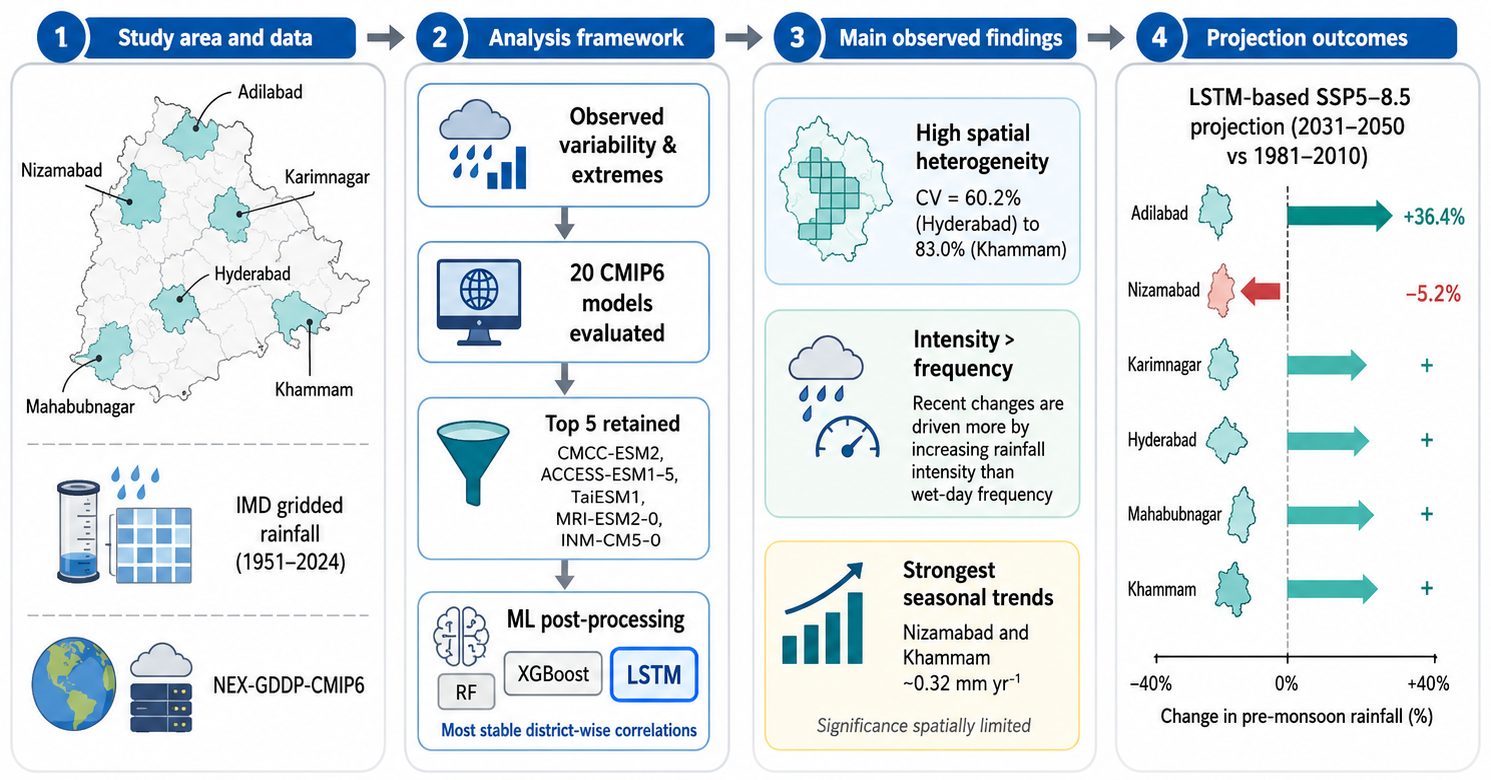
Pre-monsoon (March-May; MAM) rainfall over Telangana is highly variable, yet district-scale evidence on its variability, extremes, and near-term change remains limited. This study combines India Meteorological Department gridded rainfall observations (1951-2024), bias-corrected NEX-GDDP-CMIP6 simulations, and machine-learning (ML) post-processing to examine MAM rainfall in six contrasting districts: Adilabad, Nizamabad, Karimnagar, Hyderabad, Mahabubnagar, and Khammam. Observations show strong spatial heterogeneity, with coefficients of variation from 60.2% in Hyderabad to 83.0% in Khammam. Trend decomposition indicates that recent changes are more closely linked to increasing rainfall intensity than wet-day frequency; the strongest seasonal trends occur in Nizamabad and Khammam (about 0.32 mm yr-1), although statistical significance is spatially limited. Twenty CMIP6 models were evaluated using a composite performance index based on correlation, normalized error, variability ratio, and bias. The five best-performing models, CMCC-ESM2, ACCESS-ESM1-5, TaiESM1, MRI-ESM2-0, and INM-CM5-0, were retained for ML post-processing. Random Forest, XGBoost, and LSTM showed comparable skill during independent testing, but LSTM produced more stable district-wise correlations while still underestimating peak rainfall years. Under SSP5-8.5, LSTM-based projections for 2031-2050 indicate changes from -5.2% in Nizamabad to +36.4% in Adilabad relative to 1981-2010, supporting localized interpretation rather than broad generalization for regional climate-risk assessment and adaptation planning practice.
References
- Baño-Medina, J., Manzanas, R., Gutiérrez, J.M. (2020). Configuration and Intercomparison of Deep Learning Neural Models for Statistical Downscaling. Geoscientific Model Development, 13, 2109-2124, doi: 10.5194/gmd-13-2109-2020
- Beucler, T., Pritchard, M., Rasp, S., Ott, J., Baldi, P., Gentine, P. (2021). Enforcing Analytic Constraints in Neural Networks Emulating Physical Systems. Physical Review Letters, 126. doi: 10.1103/physrevlett.126.098302
- Breiman, L. (2001). Random forests. Machine Learning, 45, 5-32.
- Chen, L., Han, B., Wang, X., Zhao, J., Yang, W., Yang, Z. (2023). Machine Learning Methods in Weather and Climate Applications: A Survey. Applied Sciences, 13(21), 12019, doi: 10.3390/app132112019
- Chen, T., Guestrin, C. (2016). XGBoost: A Scalable Tree Boosting System. In: The Proceeding Book of the 22nd ACM SIGKDD International Conference on Knowledge Discovery and Data Mining, California, USA, 785-794, doi: 10.1145/2939672.2939785
- Eyring, V., Bony, S., Meehl, G.A., Senior, C.A., Stevens, B., Stouffer, R.J., Taylor, K.E. (2016). Overview of the Coupled Model Intercomparison Project Phase 6 (CMIP6) Experimental Design and Organization. Geoscientific Model Development, 9(5), 1937-1958, doi: 10.5194/gmd-9-1937-2016
- Gadgil, S., Gadgil, S. (2006). The Indian Monsoon, GDP and Agriculture. Economic and Political Weekly, 4887-4895, doi: 10.2307/4418949
- Goswami, B.N., Venugopal, V., Sengupta, D., Madhusoodanan, M.S., Xavier, P.K. (2006). Increasing Trend of Extreme Rain Events Over India in a Warming Environment. Science, 314(5804), 1442-1445, doi: 10.1126/science.1132027
- Guilbert, M., Terray, P., Mignot, J. (2023). Intermodel spread of historical Indian monsoon rainfall change in CMIP6: the role of the tropical Pacific mean state. Journal of Climate, 36, 3937-3953, doi: 10.1175/jcli-d-22-0585.1
- Hawkins, E., Sutton, R. (2012). Time of Emergence of Climate Signals. Geophysical Research Letters 39, L01702, doi: 10.1029/2011gl050087
- Hochreiter, S., Schmidhuber, J. (1997). Long Short-Term Memory. Neural Computation, 9, 1735-1780, doi: 10.1162/neco.1997.9.8.1735
- Houze, R.A., Wilton, D.C., Smull, B.F. (2007). Monsoon Convection in the Himalayan Region as Seen by the TRMM Precipitation Radar. Quarterly Journal of the Royal Meteorological Society, doi: 10.1002/qj.106
- Kendall, M.G. (1957). Rank Correlation Methods. Biometrika, 44, 298, doi: 10.2307/2333282
- Krishnan, R., Sanjay, J., Gnanaseelan, C., Mujumdar, M., Kulkarni, A., Chakraborty, S. (2020). Assessment of climate change over the Indian Region. A report of the Ministry of Earth Sciences (MoES), Government of India. Springer Singapore.
- Kumar, K., Kumar, K., Ashrit, R.G., Deshpande, N.R., Hansen, J.W. (2004). Climate Impacts on Indian Agriculture. International Journal of climatology, 24(11), 1375-1393, doi: 10.1002/joc.1081
- Kushwaha, P., Pandey, V.K., Kumar, P., Sardana, D. (2024). CMIP6 Model Evaluation for Mean and Extreme Precipitation Over India. Pure and Applied Geophysics, 181, 655-678. doi: 10.1007/s00024-023-03409-5
- Mann, H.B. (1945). Nonparametric Tests Against Trend. Econometrica, 13, 245, doi: 10.2307/1907187
- Maraun, D., Widmann, M., Gutiérrez, J.M. (2018). Statistical Downscaling Skill Under Present Climate Conditions: A Synthesis of the VALUE Perfect Predictor Experiment. International Journal of Climatology, 39, 3692-3703, doi: 10.1002/joc.5877
- Maurer, E.P., Hidalgo, H.G. (2008). Utility of Daily vs. monthly large-scale climate data: An Intercomparison of Two Statistical Downscaling Methods. Hydrology and Earth System Sciences, 12, 551-563, doi: 10.5194/hess-12-551-2008
- Meehl, G.A., Goddard, L., Boer, G., Burgman, R., Branstator, G., Cassou, C., Corti, S., Danabasoglu, G., Doblas-Reyes, F., Hawkins, E., Karspeck, A., Kimoto, M., Kumar, A., Matei, D., Mignot, J., Msadek, R., Navarra, A., Pohlmann, H., Rienecker, M., Rosati, T., Schneider, E., Smith, D., Sutton, R., Teng, H., Jan van Oldenborgh, G., Vecchi, G., Yeager, S. (2014). Decadal Climate Prediction: An Update from the Trenches. Bulletin of the American Meteorological Society, 95, 243-267, doi: 10.1175/bams-d-12-00241.1
- Moon, S., Ha, K-J. (2020). Future Changes in Monsoon Duration and Precipitation Using CMIP6. npj Climate and Atmospheric Science 3(1), 45, doi: 10.1038/s41612-020-00151-w
- Mukherjee, S., Aadhar, S., Stone, D., Mishra, V. (2018). Increase in Extreme Precipitation Events Under Anthropogenic Warming in India. Weather and Climate Extremes, 20, 45-53, doi: 10.1016/j.wace.2018.03.005
- Pai, D.S., Rajeevan, M., Sreejith, O.P., Mukhopadhyay, B., Satbha, N.S. (2014). Development of a new high spatial resolution (0.25× 0.25) long period (1901-2010) daily gridded rainfall data set over India and its comparison with existing data sets over the region. Mausam, 65(1), 1-18, doi: 10.54302/mausam.v65i1.851
- Ramsey, P.H. (1996). Statistical Methods in the Atmospheric Sciences. Technometrics, 38(4), 402, doi: 10.1080/00401706.1996.10484553
- Reichstein, M., Camps-Valls, G., Stevens, B., Jung, M., Denzler, J., Carvalhais, N., Prabhat, F. (2019). Deep Learning and Process Understanding for Data-Driven Earth System Science. Nature, 566(7743), 195-204, doi: 10.1038/s41586-019-0912-1
- Roxy, M.K., Ghosh, S., Pathak, A., Athulya, R., Mujumdar, M., Murtugudde, R., Terray, P., Rajeevan, M. (2017). A Threefold Rise in Widespread Extreme Rain Events Over Central India. Nature Communications, 8(1), 708, doi: 10.1038/s41467-017-00744-9
- Sen, P.K. (1968). Estimates of The Regression Coefficient Based on Kendall’s Tau. Journal of the American Statistical Association, 63(324), 1379-1389, doi:10.1080/01621459.1968.10480934
- Thrasher, B., Maurer, E.P., McKellar, C., Duffy, P.B. (2012). Bias Correcting Climate Model Simulated Daily Temperature Extremes with Quantile Mapping. Hydrology and Earth System Sciences, 16(9), 3309-3314, doi: 10.5194/hess-16-3309-2012
- Thrasher, B., Wang, W., Michaelis, A., Melton, F., Lee, T., Nemani, R. (2022). NASA Global Daily Downscaled Projections, CMIP6. Scientific Data, 9(1), 262, doi: 10.1038/s41597-022-01393-4
- Turner, A.G., Annamalai, H. (2012). Climate Change and the South Asian Summer Monsoon. Nature Climate Change, 2, 587-595, doi: 10.1038/nclimate1495
- Wood, A.W. (2002). Long-Range Experimental Hydrologic Forecasting for the Eastern United States. Journal of Geophysical Research, 107(D20), 4429, doi: 10.1029/2001jd000659
- Zhang, X., Alexander, L., Hegerl, G.C., Jones, P., Tank, A.K., Peterson, T.C., Trewin, B., Zwiers, F. W. (2011). Indices for monitoring changes in extremes based on daily temperature and precipitation data. Wiley Interdisciplinary Reviews: Climate Change, 2(6), 851-870, doi: 10.1002/wcc.147
Share Article
 Share Article on Twitter
 Share Article on Facebook
 Share Article on LinkedIn
Article Summery
ISSN : 3023-7343
Volume 3 Issue 1
 Doi : 10.71350/tethysjournal.6
Submission Date: 2026-05-10
Accepted Date : 2026-06-23
Available Online : 2026-06-28
Publication Date :2026-06-29
46
54010
224289
20days
50days
10days